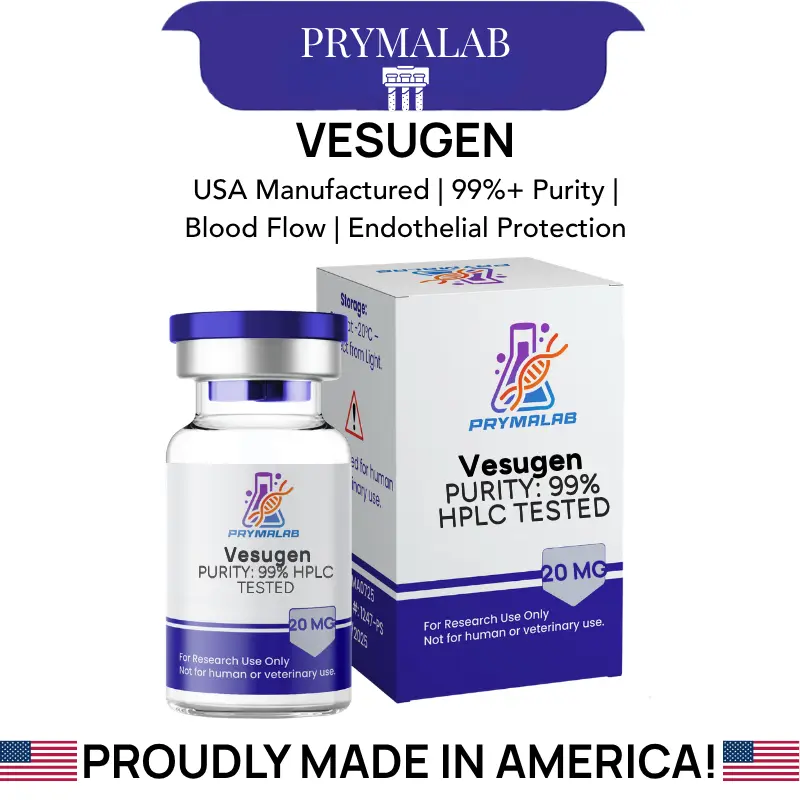
Vesugen 20mg is a lyophilized vial of the tripeptide Lys-Glu-Asp, CAS 204271-66-9, molecular formula C15H26N4O8, molecular weight approximately 390.4. It belongs to the short peptide bioregulator class developed at the St Petersburg Institute of Bioregulation and Gerontology.
Specification Table
Vesugen verified chemical and handling data
| Property |
Value |
| Compound |
Vesugen |
| Sequence designation |
KED, Lys-Glu-Asp |
| CAS number |
204271-66-9 |
| Molecular formula |
C15H26N4O8 |
| Molecular weight |
Approximately 390.4 g/mol |
| Residue count |
3 |
| Amino acid sequence |
Lysine-Glutamate-Aspartate |
| Compound class |
Short peptide bioregulator, cytogen subclass |
| Originating programme |
St Petersburg Institute of Bioregulation and Gerontology |
| Programme lead |
Vladimir Khavinson |
| Source tissue of the parent fraction |
Calf and porcine aorta |
| Proposed mechanism in the literature |
Sequence-specific interaction with DNA, modulating tissue-associated gene expression |
| Mechanism status |
Hypothesis. Not independently established outside the originating programme |
| Indexed publications |
Approximately 27 in PubMed at time of writing |
| Vial content |
20 mg lyophilized powder |
| Molar content of vial |
Approximately 51.2 µmol |
| Appearance |
White lyophilized powder |
| Purity |
Per lot-specific certificate of analysis |
| Solubility |
Water soluble |
| Storage, lyophilized |
2-8°C or -20°C, protected from light and moisture |
| Oxidation-prone residues |
None |
| Regulatory status |
No approved human or veterinary formulation in any jurisdiction |
What Is a Peptide Bioregulator?
The term describes a specific research tradition rather than a pharmacological class, and understanding its origins explains both the appeal and the limitations.
The programme began at the St Petersburg Institute of Bioregulation and Gerontology, where Vladimir Khavinson and colleagues fractionated animal tissue extracts over several decades. The working idea was that extracts from a given organ contained short peptides carrying regulatory information specific to that tissue, and that progressively purifying those extracts would isolate the active sequences.
Vesugen emerged from vascular tissue, specifically calf and porcine aorta. Other members of the family derive from thymus, pineal, liver, prostate and other organs, and each is described as retaining organ-specific activity.
The class divides into cytomaxes, which are peptide-containing tissue extracts, and cytogens, which are laboratory-synthesised short sequences designed to reproduce the extract activity. Vesugen is a cytogen: a defined synthetic tripeptide rather than a fraction.
That distinction matters analytically. A synthetic tripeptide can be characterised completely by mass spectrometry and chromatography. A tissue extract cannot.
What Is the Proposed Mechanism, and How Well Established Is It?
The hypothesis put forward in this literature is that short peptides interact with DNA in a sequence-specific manner, binding in the major or minor groove and modulating transcription of genes associated with the tissue the peptide derives from.
It is a striking proposal. Sequence-specific DNA recognition normally requires a folded protein presenting a recognition surface across many base pairs, and a three-residue peptide has neither the size nor the structure conventionally thought necessary.
Published work from the originating programme includes molecular modelling and binding studies advanced in support. Independent confirmation from unaffiliated structural biology laboratories is limited, and the mechanism has not been established to the standard that would be expected for a novel mode of gene regulation.
The honest position is that this is a hypothesis with supporting work from one research tradition, not a settled mechanism. A researcher using Vesugen should treat the DNA-binding model as the thing to test rather than the explanation to build on.
What is not in doubt is the chemistry. Lys-Glu-Asp is a defined tripeptide of known mass and composition, and whatever it does or does not do, the material itself is straightforward to characterise.
How Does Vesugen 20mg Compare With Other Short Peptides Here?
Placing Vesugen 20mg alongside the catalogue clarifies what kind of compound it is.
KPV is also a tripeptide, also water soluble, also carrying no oxidation-prone residues. The difference is provenance and evidence. KPV is the C-terminal fragment of a characterised human hormone with a defined transporter and a named downstream pathway published across independent laboratories. Vesugen derives from a tissue fractionation programme with a proposed mechanism that remains largely within that programme.
That comparison is not a dismissal. It is a description of where the evidence sits, and researchers choosing between short peptides should know that the two occupy different evidentiary positions despite superficial similarity.
Handling is comparable. Three residues, no cysteine, no methionine, no aromatic residues at all in this case, which places Vesugen at the durable end of this entire catalogue. It does not oxidise appreciably, cannot form disulfides, and has no structure to lose.
Twenty milligrams at 390.4 daltons is approximately 51.2 micromoles, a substantial molar quantity for a small peptide and considerably more material than most designs will consume quickly.
What Would a Rigorous Vesugen Experiment Look Like?
Given the state of the mechanism, the most valuable work is testing the proposal rather than assuming it.
For the DNA-binding hypothesis, direct biophysical measurement is the appropriate approach. Isothermal titration calorimetry, surface plasmon resonance against immobilised oligonucleotides, or electrophoretic mobility shift assays all measure binding directly rather than inferring it from downstream expression.
A scrambled-sequence control is essential. If Lys-Glu-Asp binds a specific DNA sequence, then Glu-Lys-Asp or Asp-Glu-Lys should not, and a peptide with identical composition in different order is the cleanest available comparator.
For expression work, a transcriptomic readout is more informative than a targeted panel, because a targeted panel can only find what it was designed to look for and the hypothesis makes no strongly specific prediction about which genes should move.
Concentration matters. The proposed mechanism offers no guidance on what concentration should be active, so a wide concentration-response range is more defensible than a single point chosen from secondary literature.
How Should Vesugen 20mg Be Positioned Against the Literature?
Reading this compound accurately means separating three things that discussions of it tend to merge.
The chemistry is settled. Lys-Glu-Asp is a defined tripeptide of known mass, composition and CAS registration, synthesisable to high purity and fully characterisable by routine analytical methods. Nothing about the material itself is in question.
The provenance is documented. The St Petersburg programme, its fractionation methodology, its publication record and its personnel are all matters of record spanning several decades, with roughly twenty-seven indexed publications addressing this specific sequence.
The mechanism is not established. The proposal that a three-residue peptide achieves sequence-specific DNA recognition has support from within the originating programme and limited independent structural confirmation, and it conflicts with the conventional understanding of how DNA recognition works.
Conflating those three is what produces overconfident descriptions. A compound can have impeccable chemistry, a documented research history, and an unresolved mechanism simultaneously, and Vesugen does.
For a researcher the practical reading is that the material is reliable and the hypothesis is open, and that combination is actually favourable, since a well-defined compound with an untested mechanism is exactly what a careful experiment can address.
What Does Twenty Milligrams Support Experimentally?
A large molar quantity of a small stable peptide opens designs that a milligram of a larger peptide would not.
Fifty-one micromoles supports biophysical measurement, which is where the mechanistic question actually lies. Isothermal titration calorimetry consumes considerably more material than a cell assay, and it measures binding directly rather than inferring it.
It supports wide concentration ranging. Where no affinity is known, covering several orders of magnitude is necessary rather than thorough, and that consumes material quickly at the upper end.
It supports proper controls. A scrambled-sequence arm doubles material consumption, and a full comparison against other short peptides in the same family multiplies it further.
It also supports crystallography or nuclear magnetic resonance work on the peptide-DNA question, both of which need material at this scale and either of which would address the mechanism more decisively than another expression study.
For a compound whose central claim is untested, having enough material to test it properly is the practical argument for the larger format.
What Should a Vesugen 20mg Certificate Show?
Three residues is about as simple as peptide analysis gets, which means there is no excuse for a thin certificate.
Mass confirmation against 390.4 for the free peptide. Purity by reversed-phase chromatography, which for a tripeptide should be a clean single peak with any impurities well separated rather than shouldering the main signal.
Counterion identity and net peptide content matter more here than for a larger peptide. At 390.4 daltons a single trifluoroacetate at 114 daltons represents over twenty percent of the associated mass, so a Vesugen 20mg vial may contain considerably less than twenty milligrams of actual tripeptide.
That correction is large enough to change a concentration-response curve visibly. Requesting net peptide content, and calculating from it rather than from the vial label, is the difference between an accurate molarity and a systematically inflated one.
Water content by Karl Fischer completes the set.
Reconstitution and Storage in Laboratory Practice
Twenty milligrams is approximately 51.2 micromoles. Reconstituted into 2 ml that gives roughly a 25.6 mM stock, into 10 ml roughly 5.1 mM. Choose against the working range before opening.
Water solubility makes Vesugen 20mg dissolution straightforward. Run diluent gently down the inside of the vial and swirl once or twice. Preparations that resist dissolving are worth questioning rather than agitating harder.
This is one of the more forgiving compounds in the catalogue. With no cysteine, no methionine and no aromatic residues, the usual oxidation and photodegradation concerns largely do not apply, and freeze-thaw tolerance is good.
Counterion identity remains worth requesting. At 390.4 daltons, a trifluoroacetate counterion from synthesis represents a substantial proportion of weighed mass, and the mass-to-mole conversion shifts accordingly. Record lot, counterion where known, diluent, volume, concentration and date.
Published Literature
Each citation was checked against the publisher record or a primary index. The concentration of this literature in one research programme is discussed in the sections above.
- Khavinson VK, Malinin VV. Gerontological Aspects of Genome Peptide Regulation. Karger, Basel; 2005.
- Khavinson VK. Neuroendocrinology Letters. 2002;23(Suppl 3):11-144.
- Khavinson VK, Solovyov AY, Zhilinsky DV, Shataeva LK, Bandaletova TY. Bulletin of Experimental Biology and Medicine. 2012;153(4):500-505.
- Anisimov VN, Khavinson VK. Critical Reviews in Oncology/Hematology. 2010;74(1):46-66.
- Fedoreyeva LI, Kireev II, Khavinson VK, Vanyushin BF. Biochemistry (Moscow). 2011;76(11):1210-1219.
Frequently Asked Questions
What is Vesugen 20mg?
A lyophilized vial of the tripeptide Lys-Glu-Asp, CAS 204271-66-9, molecular weight approximately 390.4. Twenty milligrams is roughly 51.2 micromoles. It belongs to the short peptide bioregulator class from the St Petersburg programme. Laboratory research use only.
What is a peptide bioregulator?
A term describing a research tradition rather than a pharmacological class. The St Petersburg programme fractionated animal tissue extracts over decades, working from the idea that organ extracts contain short peptides carrying tissue-specific regulatory information.
What is the difference between a cytomax and a cytogen?
Cytomaxes are peptide-containing tissue extracts. Cytogens are laboratory-synthesised short sequences designed to reproduce the extract activity. Vesugen is a cytogen, meaning a defined synthetic tripeptide rather than a fraction, which makes it fully characterisable analytically.
What is the proposed mechanism?
That short peptides interact with DNA in a sequence-specific manner, binding in the major or minor groove and modulating transcription of genes associated with the source tissue. It is a striking proposal, since sequence-specific DNA recognition normally requires a folded protein.
How well established is that mechanism?
Not well. Published support comes largely from the originating programme, including molecular modelling and binding studies. Independent confirmation from unaffiliated structural biology laboratories is limited, and it has not been established to the standard expected for a novel mode of gene regulation.
How does Vesugen compare with KPV?
Both are water-soluble tripeptides with no oxidation-prone residues, so handling is comparable. They differ in evidence. KPV is a fragment of a characterised human hormone with a defined transporter and named pathway published across independent laboratories. Vesugen occupies a different evidentiary position.
How would the DNA-binding hypothesis be tested?
By direct biophysical measurement rather than inference from expression. Isothermal titration calorimetry, surface plasmon resonance against immobilised oligonucleotides, or electrophoretic mobility shift assays all measure binding directly. A scrambled-sequence control is essential alongside any of them.
Why is a scrambled control essential here?
Because if Lys-Glu-Asp binds a specific DNA sequence, then a peptide with identical amino acid composition in a different order should not. That comparator distinguishes sequence-specific recognition from a generic effect of a small charged peptide.
Is Vesugen chemically durable?
It sits at the durable end of this catalogue. Three residues, no cysteine so no disulfides, no methionine or aromatic residues so oxidation and photodegradation are not significant routes, and no secondary structure to lose. Freeze-thaw tolerance is good.
What should be requested on the certificate?
Counterion identity in particular. At 390.4 daltons a trifluoroacetate counterion from synthesis represents a substantial proportion of weighed mass, so the mass-to-mole conversion shifts noticeably. Mass confirmation, purity and water content complete the useful set.
Compliance Statement
Vesugen 20mg is sold exclusively for laboratory research use. It is not a drug, food, or cosmetic product, and it is not a dietary product of any kind. It is not approved by the FDA or any comparable authority for human or veterinary use, and its proposed mechanism has not been independently established. This product is not intended to diagnose, treat, cure, or prevent any disease. It must not be given to humans or animals. Purchase is restricted to qualified researchers and institutions operating within applicable laws. All handling is the responsibility of the purchasing laboratory.












Reviews
There are no reviews yet.